
The RPD® Advantage
RPD® gives manufacturers a qualified alternative to conventional titanium forging for the right structural applications. It combines near-net-shape material efficiency, high deposition throughput, forging-level material performance, and industrial-scale production capacity.
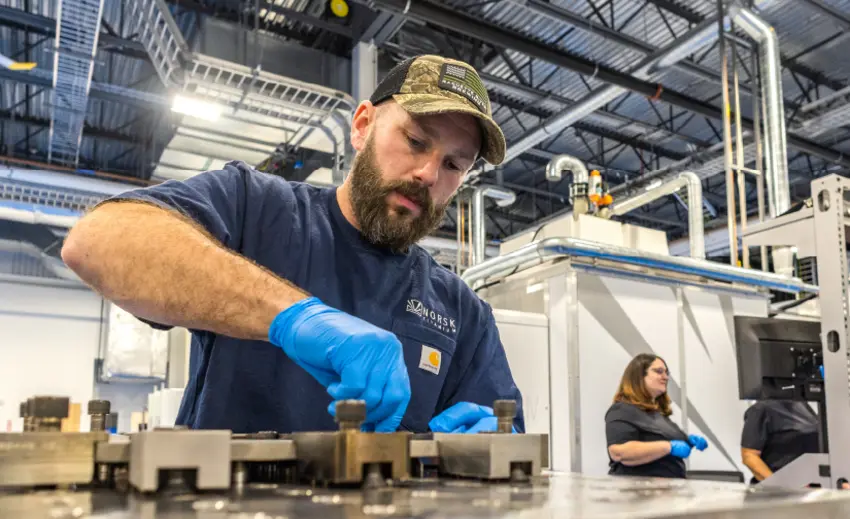
RPD® is strongest where forging creates friction.
Conventional forging remains important, but it is not always the most efficient path. For many structural titanium parts, the legacy process requires long-lead tooling, excess raw material, multiple suppliers, and significant machining before the final part is complete.
RPD® changes the starting point. By building a near-net-shape preform directly from titanium wire with no part-specific dies required, Norsk Titanium helps customers reduce waste, shorten development and supply timelines, and improve production flexibility.
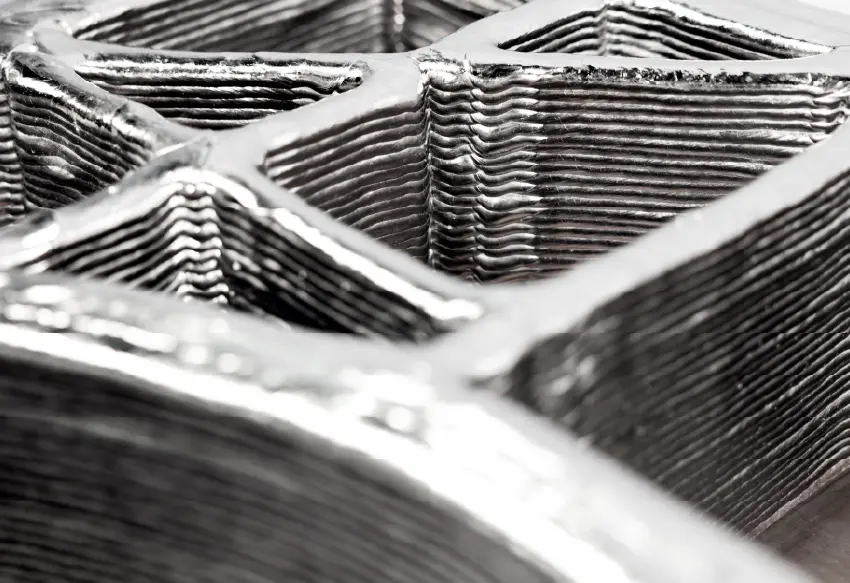
The efficiency step-change, quantified.
Manufacturing the same finished part with a fraction of the material and machining. A 220 kg forged block becomes an 80 kg RPD® print and a <10 kg finished part. The savings compound across raw material, cost, energy, and carbon.
Lower Buy-To-Fly
RPD® reduces the titanium required to produce a finished component, creating a material-cost advantage over forging or billet machining.
Shorter Lead Times
Because RPD® requires no part-specific forging dies, customers cut dependence on long tooling schedules and constrained forging queues.
Forging-Level Performance
RPD® delivers forging-equivalent material properties for applications that demand rigorous performance and qualification discipline.
Scalable Production
Norsk Titanium's 650 MT of installed capacity across three facilities let customers move beyond prototypes into recurring supply.
Supply-Chain Resilience
RPD® adds a qualified production path that reduces risk in programs where schedule, source availability, and supply concerns exist.
End-to-End Manufacturing Fit
Norsk Titanium evaluates the full workflow from preform design through machining, inspection, and customer qualification.
A practical alternative to legacy titanium production.
| Customer Challenge | Conventional Forging Constraint | RPD® Advantage |
|---|---|---|
| High titanium waste | Large forged or billet input must be machined down | Near-net-shape preform — up to 75% less material |
| Long lead times | Dies, queues, and multi-step supplier networks can delay supply | No part-specific forging die required |
| Cost pressure | Material, machining, tooling, and inventory all compound cost | Up to 70% less machining; ~40% lower total part cost |
| Supply-chain risk | Limited qualified capacity can constrain production | Qualified, ITAR-registered U.S. source |
| Part adoption | New process must satisfy engineering, quality, and procurement | Nadcap, AS9100D, AMS 7004/7005, MMPDS-published data |
Part selection determines the business case.
RPD® is not the answer for every part. It is a production advantage when the application fits the process — medium-to-large structural components with high forging or machining waste, simple-to-moderate geometry, and recurring, certifiable demand. It is not the fit for very small parts, fine internal channels, or ultra-tight-tolerance features required straight from build.
Norsk Titanium works with customers to evaluate geometry, material requirements, loading conditions, machining allowances, inspection needs, production volume, and qualification pathway before recommending RPD®. This discipline protects the customer's business case and ensures RPD® is applied where it can deliver measurable value.
Ready to put RPD® to work in your supply chain?
Whether you are evaluating a new titanium structure, looking for an alternative to forging, or working to improve production resilience, Norsk Titanium can help determine where RPD® fits, and can move a strong-fit part from candidate to qualified production in about six months.
Request a Meeting